- Details
- Hits: 5
|
|
||
|
What if skating isn’t just another sport? What if it is where children learn how to move?
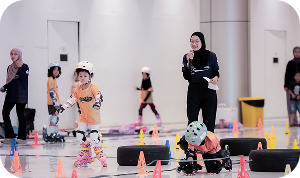
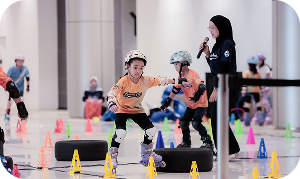
For parents, choosing a sport often starts with a simple question: “What will my child enjoy? Soccer? Basketball? Swimming? Gymnastics?” But before children can become good at any sport, they need something more basic: body control. Inline skating gives children a unique opportunity to develop them. Inline skating asks children to control their bodies in motion. They have to balance, shift their weight, stabilize their core, coordinate both sides of the body, and react quickly when their direction changes.
The body has to keep adapting. That is the skill.Research has found that structured inline skating can improve balance and lower-body strength in children. One study found measurable improvements after just four weeks of structured skating compared with a control group.
And skating doesn’t stop at balance.Skating develops agility, spatial awareness, bilateral coordination, and the ability to control movement while constantly changing direction, skills that travel. A child who learns to control their body on wheels develops a stronger movement foundation for other activities too. Soccer needs quick footwork. Basketball needs balance and direction changes. Gymnastics demands body awareness and control. Skating doesn’t replace those sports. It helps build the movement foundation underneath them.
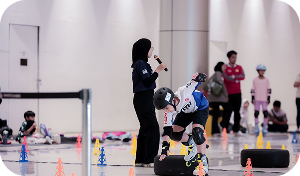
Then comes the part every parent knows can be difficult: Falling.For a beginner, losing balance can feel scary. But when children learn how to fall safely, stop properly, and get back up, falling becomes part of the process, not something to fear. Research has also reported improvements in static and dynamic balance and functional mobility following an eight-week supervised skating program in children with autism spectrum disorder. While those findings come from a specific clinical population, they add to the growing evidence around skating’s potential for movement development.
This is why how children learn matters.At Rollerskool, skating is not treated as simply putting on skates and letting children figure it out. Our five-level progression system gives children a structured pathway to develop skills step by step. From learning fundamental control to becoming more confident and capable on wheels. Because the goal is bigger than skating. It’s to become a more capable mover. And that foundation can travel far beyond the rink. Ready to see where your child’s movement journey can begin? Explore Rollerskool and experience structured skating for yourself.
ReferencesMuehlbauer, T., Kuehnen, M., & Granacher, U. (2013). Inline skating for balance and strength promotion in children during physical education. Perceptual and Motor Skills, 117(3), 665–681. https://doi.org/10.2466/30.06.PMS.117x29z9 Torabi, F., Abdolkarimi Ravari, M., & Zamankhanpour, M. (2025). The effect of skating on balance and functional mobility of children with autism disorder in Kerman. Iranian Journal of Neurodevelopmental Disorders, 4(3), 1–11. https://doi.org/10.61838/kman.jndd.4.3.8 Youth Athlete Performance. (2025). Multi sport athlete advantage: Better skills fast. https://www.youthathleteperformance.com/article
|